John Coltrane – Messenger for Peace on Earth
John Coltrane’s tour in Japan showcased his belief in channeling the individual’s role into a positive force for humanity.


“I know that there are bad forces, forces that bring suffering to others and misery to the world. I want to be the opposite force. I want to be the force which is truly for good.”
In the history of jazz, the career of tenor and soprano saxophonist John Coltrane stands as an example of human achievement in artistic self-expression. After a brilliant early career and being part of groups with Miles Davis, Thelonious Monk and other jazz legends, John Coltrane grew as an artist and expanded his music to include the ideas of spiritualism and universalism. He experienced a profound spiritual awakening in 1957, which led him to embrace a life dedicated to a greater spiritual purpose and transformed his music into a vehicle for spiritual expression.
Help us relaunch the magazine for nuclear disarmament.
In July 1966, Coltrane traveled to Japan to perform a series of concerts. It is known by the greater jazz community that Coltrane felt the trip was a chance to connect with the Japanese people after the horrors of World War II. His visit in Japan became symbolic to many people of an artist’s support of a community affected by war and the use of nuclear weapons. Even though Coltrane was not known as a politically opinionated figure, when asked in an interview (Interview by Kaname Kawachi, Tokyo Prince Hotel, Tokyo, July 9, 1966) to comment on the Vietnam War, Coltrane said: “Well, I dislike war. So, therefore, as far as I’m concerned, it should stop.”
On July 13, Coltrane performed a concert in Hiroshima. The next day, Coltrane and his quintet, visited the Nagasaki Peace Memorial Park to pay their respects to the victims of the Nagasaki bombing. Coltrane prayed, observed a moment of silence, and placed a wreath on the memorial of those killed. Later that night, he played a concert in Nagasaki.
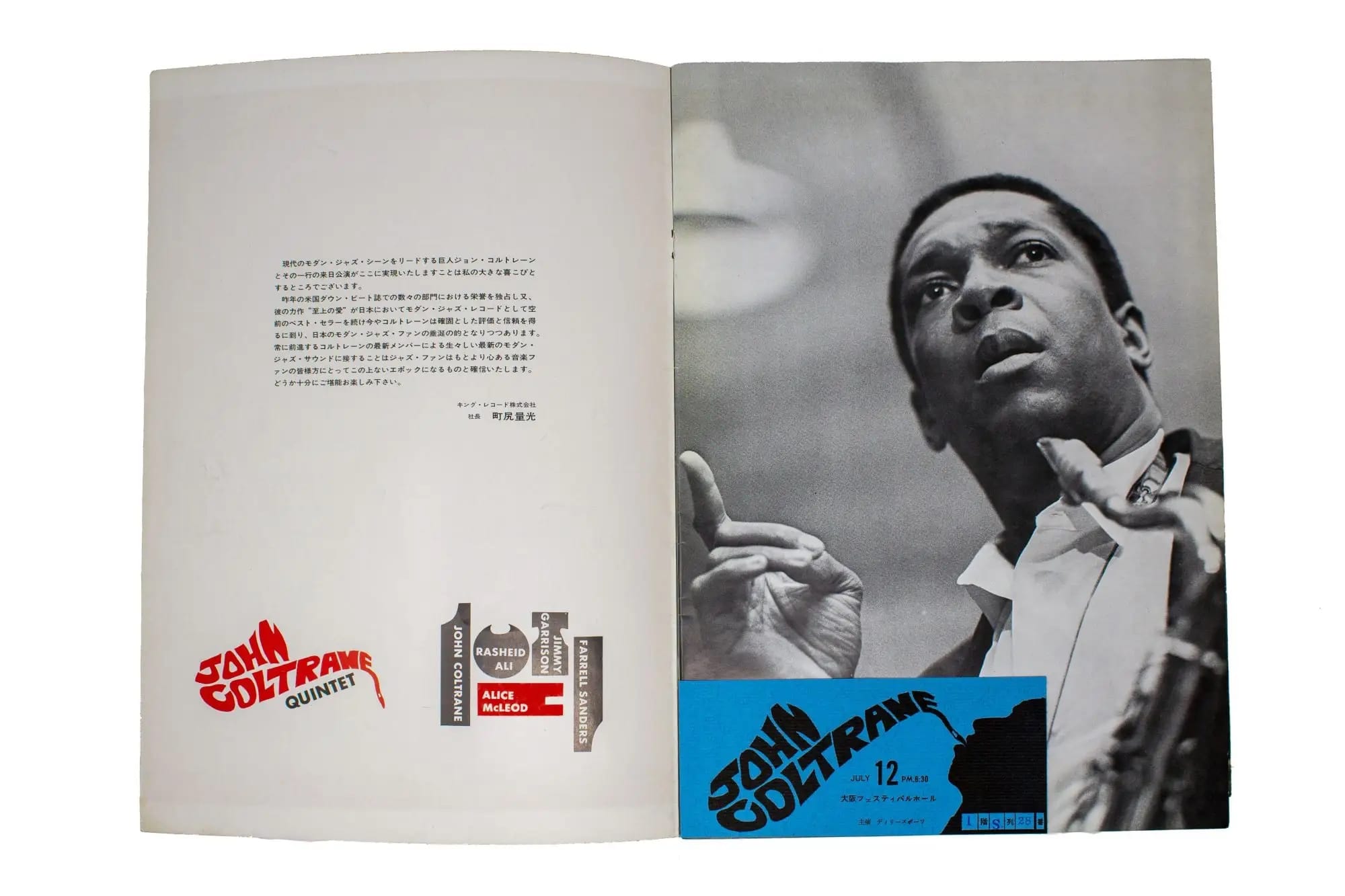
As part of his tour, Coltrane performed a new composition, Peace on Earth, that was seen as an elegy to the victims of the bombings of Hiroshima and Nagasaki and a spiritual quest to find peace and alleviate human suffering. The music was composed from the artist’s deep connection to spiritual ideas and his desire to use music as a powerful, universal language. Peace on Earth was written as a message of peace and healing through music. The performance of this piece is an example of Coltrane’s believe in channeling the individual’s role into a positive force for humanity. Coltrane created music that could facilitate spiritual reflection, upliftment, and healing for listeners. A passionate review of Coltrane’s performance written by Tokyo jazz critic and radio host Shoichi Yui, who attended both the press conference and at least one of Coltrane’s concerts, stated that the one-and-a-half-hour concert made him happy to be alive.
Coltrane believed in music as a power of good that could affect many of the world’s ills by connecting people regardless of national or religious boundaries. In an open letter in 1964, John Coltrane wrote, “I humbly asked to be given the means and privilege to make others happy through music.” To Coltrane, a musician was a messenger of peace and unity.
He further explained his musical and philosophical goals in these words: “Once you become aware of this force for unity in life, you can’t ever forget it. It becomes part of everything you do. My goal in meditating on this through music is to uplift people, to inspire them to realize more of their capacities for living meaningful lives. Because there certainly is meaning to life.”
John Coltrane’s brilliant developments in the mid to late ’60s period of jazz, including the mythical Japan ‘66 tour will always stand as a marker to his musical greatness and greatness as a human being. His music became a vehicle for his individual message of peace.
Agnieszka Nimark is a scholar and a member of the Nuclear Times editorial team
Jesse Collins is a composer and saxophonist who studied the music of John Coltrane including with Coltrane’s bassist Reggie Workman and performed with Coltrane’s drummer Rashied Ali.


#/media/File:ColtraneJapanLP.JPG)